Affichage des articles dont le libellé est Indigo. Afficher tous les articles

Vintage 40's BUCCANEER Denim Jacket

0
Vintage WWII war era indigo denim zipper jacket by BUCCANEER UNIFORM. 
There is an R stenciled in red paint on the breast pocket, and LONGFIELD over a bomb stenciled on the back. 


How Industrial Jeans Are Made?

0


ROY Denim

0
A new one video about ROY Jeans hand made!

Roy's Jeans - Video by Self Edge from Self Edge on Vimeo.


Search old post for history of Roy Slaper.

Limited LVC LEVI'S 1890 501 SELVAGE

2


 * LIMITED LVC LEVI'S 1890 - 501 SELVAGE JEANS - JAPAN *


LEVI'S VINTAGE CLOTHING (LVC) 2005AW collection special edition model, 1890's 501xx "SPUR BITE", reproduction of 1890's first 501xx, limited 501 pieces worldwide and very rare old LVC collection model which are no longer manufactured. Made in USA


Very detailed hand made distress finish, looks as if they have just been found in old miner! The fabric is blue selvage denim and the silhouette is a straight work pants cut, medium indigo blue in colour. They have total of 10 denim patched hand -sewn and two of them have intentionally been removed after been washed to create this very fascinating indigo blue contrust.

The details include early levi buttons, flattened exposed rivets, suspender buttons and cinch back, real culf leather patch and very narrow single needle arcuate stitch.

* Hand-numbered of 501 pair.


LEVI STRAUSS 1908 Catalog


Roy Slaper a.k.a. ROY DENIM

1

Roy Slaper, founder of ROY Denim,  started in this little apartment sewing jeans, or trying his best to sew jeans. After four or so months, Roy was making wearable items that his friends started purchasing. Nine months on, & after meeting certain people, he started collecting old machinery dedicated towards the art of jeans making. This meant he had to move out & find a studio space, & the obvious step forward was the development of other materials, including jackets, shirts & bags. Roy now focuses on what he really wants to be making instead of custom items, & has a reputation of perfectionism.


Roy Slaper, the man behind every cut & stitch of Roy jeans.


A tour of vintage machines and a better
understanding of his past and process.


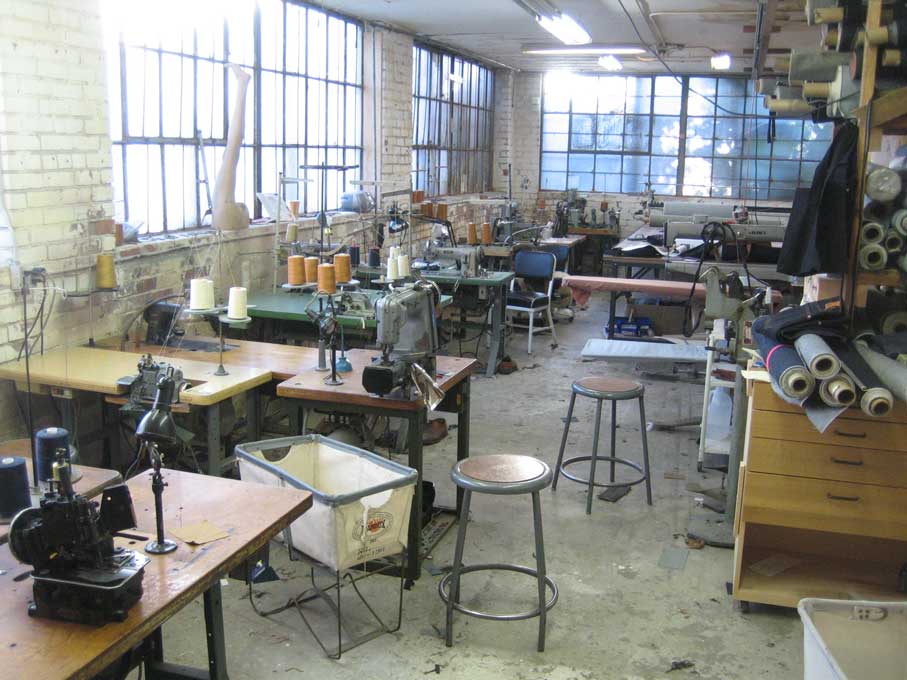
Roy's Oakland studio


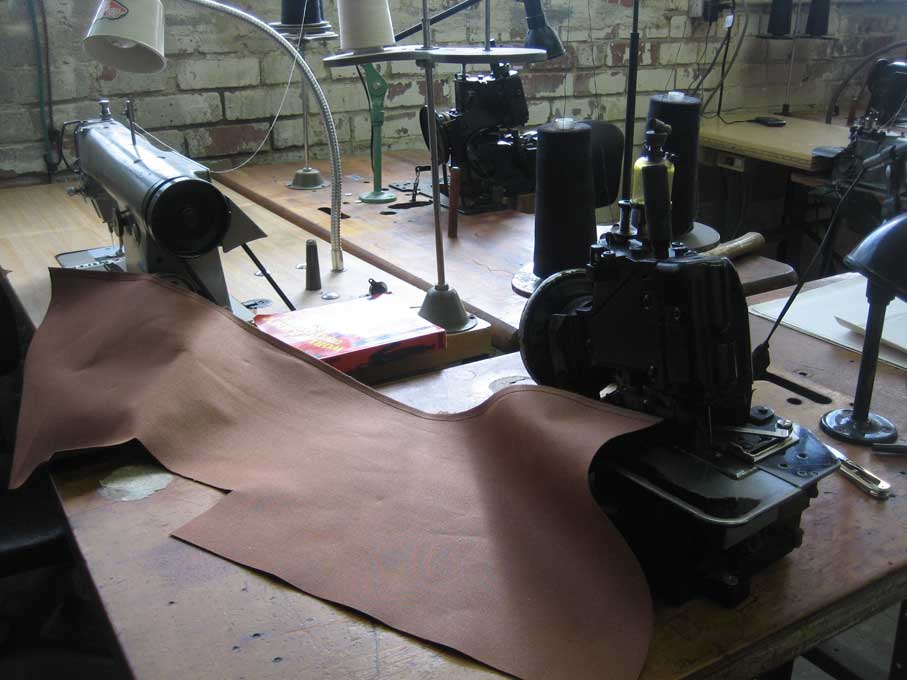
Antique Union Special sewing machine

Selvage Canvas

Roy wants to make more projects in the future & hopefully open up a storefront. The future looks bright for this artist designer & finest craftman.


Interview by Valerie Chavez on March 03 2010

Q: Tell us about the birth of Roy jeans.

I started 3 years ago in my studio apartment. The idea from the beginning was that I was going to make jeans. I bought my first machine from a man named Richard, who is now a friend, and told him that I needed a sewing machine with which to make jeans. He said, “Wait, wait, wait – why are you doing this?” What he wanted to know was whether I was motivated by money or if, as he put it, “Ok, good, you’re doing it for the love – because if you’re not, you wont make a penny.” The truth is that I didn’t know why I was doing it. I was just very driven toward making the jeans. You’re hungry and you eat.


Q: What does your crafting carry from your past? And how do you think it will direct your future?

I would first like to address the word “crafting.” I have some strong opinions about craft in the sense of craftsmanship and skill. I don’t like the association that the word has now. In the past craft meant the culmination of years of practice and training expressed and visible in the finished piece. It was a noun. In the present, the term has become synonymous with glue gunning and poor quality DIY. Its a dead term to anyone doing quality, professional work. I think its even noted archaic in Oxford’s.

I have a diverse professional history. Currently, I am a metal fabricator and have been doing this for about 10 years. The transition from metal to cloth was not difficult. Both require spacial thought, pattern making and measurement of irregular objects. So many factors from past work have helped me, it would be a very long answer to point up each one.
The interplay of my metal life and denim life is making both advance in a way that they otherwise wouldn’t have. Its good, the future is good.


Q: What do you find to be the most beautiful part of the process?

For me the actual jeans process is entwined with the fixing and care of my machines. To me, making clothing, designing, sewing and machine repair are all one subject. I really enjoy the machinery. Getting a total basketcase machine and fixing it, is right up there on the beauty scale. Second, maybe, only to finding it in the first place. Digging through some basement and finding one of my precious little heaps, that’s the most beautiful thing in the world.

Q: What would you consider quality denim, and quality jeans?

I’ve heard that you can give an old, senile person a piece of nice cloth for them to feel and it will keep them occupied pleasantly for quite a long time. If this is true, then I might be worse off than I thought. There is a complexity to quality denim that is apparent in the touch. I like to feel it and now that I’m familiar, I get the feeling in my hand when I see it. So, for me, quality denim feels good to look at.
Quality jeans last many years and get better with age. Once again, familiarity with that which lasts, helps me see quality when it is new.


Q: How important is “the machine” in crafting a quality pair of jeans?

Different machines have different characteristics. I like the character of stitch that many older machines have. Contrary to what might be expected, it is because I find the older machines to be more perfect in the actual stitch formation. I was told early on, by Billy at Apparel City, that I should get old machines because the steel was better back then. He was right. Analogies abound. “Dude, its like playing an American Fender Strat while driving a ’58 Benz while listening to a wide groove mono Kind of Blue on a Thorins turntable through a tube amp and reading the December ’68 Playboy…”


Q: If you could only take one machine with you to a desert island, which one would it be?

I think if I was going to a desert island, I would bring a treadle-power single needle lockstitch since there probably wouldn’t be any electricity. That would be handy, those castaways always get to looking so ratty.


Artisan Bicycle ;)

 
                           http://www.roydenim.com/


RALEIGH DENIM

0


Last year marked the start of made in the US denim company, Raleigh Denim. Created in the backyard of one of America’s premiere denim mills, Cone Mills, the brand has grown remarkably since our first look over one year ago. In this recent video, the story behind the brand’s start and the trials and tribulations experienced by Sarah and Victor Lytvinenko are documented. A comprehensive look into their product’s production is also a highlight for the couple who take immense pride in their American and North Carolina roots.

Founders: Victor and Sarah Lytvinenko

Raleigh Denim has rapidly gained popularity in the past couple of years due to the realization of quality found in hand-made items. Their denim is no exception. Literally made just 158 miles from our front door, their approach to a slow, hand-made process is top quality. The founders, husband and wife Victor and Sarah Lytvinenko are lovers of East Coast rap, collectors of fine goods and lovers themselves; but what we love most about them is their passion for quality goods made right here in the USA. Each pair is made from White Oak Cone Denim,hand signed and individually numbered. Raleigh Denim will stretch out and we suggest sizing down two sizes.


Originally created in 2007 under the moniker Verses jeans, the brand’s new name (changed due to a trademark dispute) speaks to Raleigh Denim’s close ties with the Carolinas. In addition to the fact that nearly all materials used come from within a 200-mile radius of the Raleigh studio, the Lytvinenkos name their locale as a key stylistic inspiration.

“What’s important to us is heritage—blending that with... our modern aesthetic,” Sarah said. “North Carolina is the heart of the textile industry. And, on a more personal level, we’ve spent most of our lives here. We like to appreciate our roots.”


Due in no small part to this emphasis on small-town origins, Raleigh Denim has become known for its sepia-toned authenticity, visible in every step of the Lytvinenkos’ creative process. True to form, all their stitching is done on vintage machines, and the inside of each pair of jeans is emblazoned with Sarah and Victor’s signatures.


Raleigh Denim has been uniquely informed by the Lytvinenkos’ position in the thick of a vibrant local art scene.

“It’s stimulating and also encouraging because people value the things we do,” Sarah said. “We’ve got a few friends in bands that wear our jeans. And we trade paintings for jeans. So we’re all sort of helping each other stay plugged in and have cool stuff.”

Among the Lytvinenkos’ artistic friends are the Rosebuds’ Ivan Howard, who has proven a loyal devotee of Raleigh Denim.

“Ivan got one of the first 10 pairs of jeans we made, and he wore them every day on stage,” Victor said.


The members of Max Indian make up more of the brand’s talent-heavy fans. Victor said neither he nor his wife knew that members of the band had Raleigh Denim jeans until one of them showed up to compliment the couple on their artistry and gift them an album.

But the connection between local jeans and local music has become about more than just swapping goods. Indeed, the music has turned into an ideal aural accompaniment to the Lytvinenkos’ line, Sarah said.

“Most of our friends that make music have a sound that we appreciate so it’s inspirational in that way,” she said. “I think their sound kind of matches our aesthetic.”


The Lytvinenkos’ web of creative acquaintances has also influenced where the jeans are sold in the Triangle area, no small feat considering how notoriously difficult it is to acquire a pair of the jeans locally. The only North Carolina location that currently stocks Raleigh Denim is the Raleigh-based Stitch, owned by bag designer Holly Aiken. In addition to the fact that Aiken’s bags are of a similarly unique, hand-crafted vein as Raleigh Denim, Aiken credits her acquisition of the line to her friendship with Victor and Sarah.


Yet even apart from the mystique of a denim-loving Triangle-area elite, Raleigh Denim is holding its own, continuing to grow in popularity despite a still-dire economic atmosphere. Credit this to the genuine appeal of a product that displays a clear human touch.

“People are willing to spend a little more for... a little bit of a story,” Victor said.


Raleigh Denim: Handcrafted in North Carolina from David Huppert on Vimeo.


MOMOTARO DENIM - JAPAN

1


Momotaro Jeans are named after another mythological character: Momotaro, an enormously powerful and brave boy who jumped out of a gigantic peach floating down a river. Hence the cute pink peach in the company’s logo.


The jeans are made around Momotaro’s mythical place of birth, Okayama, since hundreds of years Japan’s capital of cotton weavers. It was actually here that Japan’s first fully domestic jeans were created in 1973. Since then, Okayama, and neighboring Hiroshima, have become the world’s mecca for denim designers. Fashion designers from all over the world visit here regularly.


Momotaro Jeans’ high quality stems from several sources. An important one is the cotton used. The company only uses handpicked Zimbabwe Cotton. This cotton provides a high luster, while its well-proportioned fiber structure makes it pliable and perfect for dyeing. When Zimbabwe cotton is dyed with a traditional artisan method called Sho-Ai (True or Natural Indigo) which uses water to which lime, sugar and sake are added, it creates a unique vertical fade. This is known as Tateochi.


Fine long fiber cotton used in production of Momotaro Jeans


The company also employs rope dyeing. This is a technique that keeps the core of the denim thread white, thereby producing a bolder patina. Momotaro Jeans’ traditional way of dyeing is combined with using special looms. One of its looms is one of only two in the world! It takes at least three days to finish the denim on this original hand weaving machine, and requires adjusting the tension on the loom according to the temperature and humidity of the day. This creates a quality, clear uneven surface and color that few, if any, competitors can match.


Original Momotaro Jeans Denim Fabric is woven
in Vintage Denim Mills using classic shuttle looms

Original Momotaro Jeans Denim Fabric
produced with Vintage Shuttle Looms

The picture shows blue dyed hands of a natural indigo craftsman


Momotaro Jeans receive their finishing touches on special vintage sewing machines that have been replaced with modern equipment just about everywhere else.


Momotaro Jeans are sewn by artisans using Vintage sewing machines
 like Union Special. Made by hand without compromise.

Vintage Jeans made with Vintage Union Special sewing machine

Momotaro Jeans signature buttons


The company’s slogan is Made by hand without compromise. Prices reflect that. Although the company offers products over a wide range of prices, the most exclusive Momotaro Jeans set you back a cool 2,000 dollars.


Some of finest Momotaro denim heavy used,
often worn several months without washing